3-D showcase¶
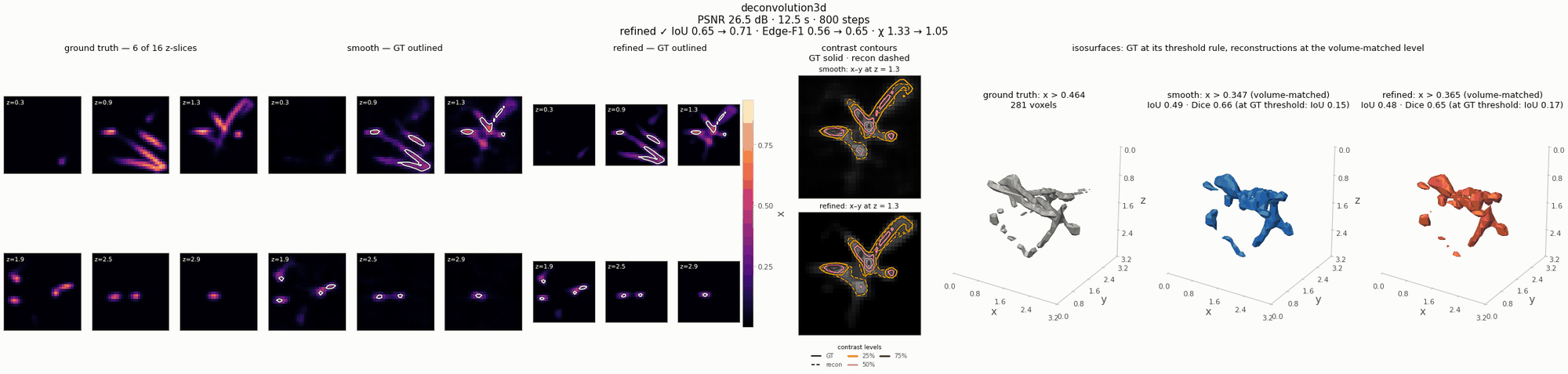
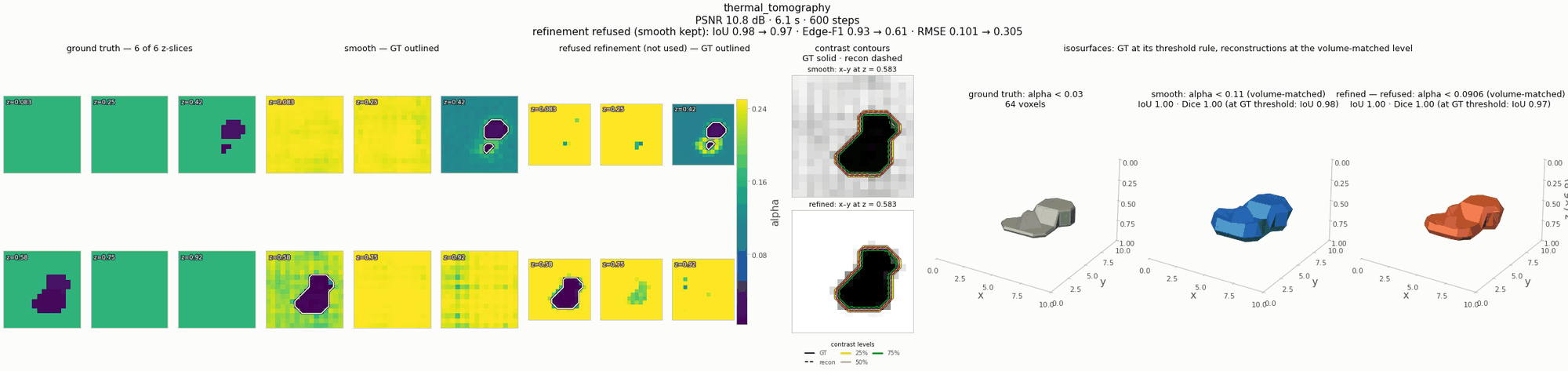
Five of the registered problems are volumetric: pulsed thermography (NeFTY), sparse-view CT, fluorescence z-stack deconvolution, diffuse optical tomography and photoacoustic tomography. For each, the gallery shows the smooth neural-field reconstruction next to its edge-refined version, and the viewers below let you rotate them against the ground truth.
Interactive viewers¶
Each viewer is one self-contained HTML file written by
nefi.viz.save_volume_viewer:
plain JavaScript on a canvas, no libraries, no network. Drag to rotate, scroll or pinch to zoom,
right-drag or shift-drag to pan, double-click to reset; the cameras of the three panels are
linked.
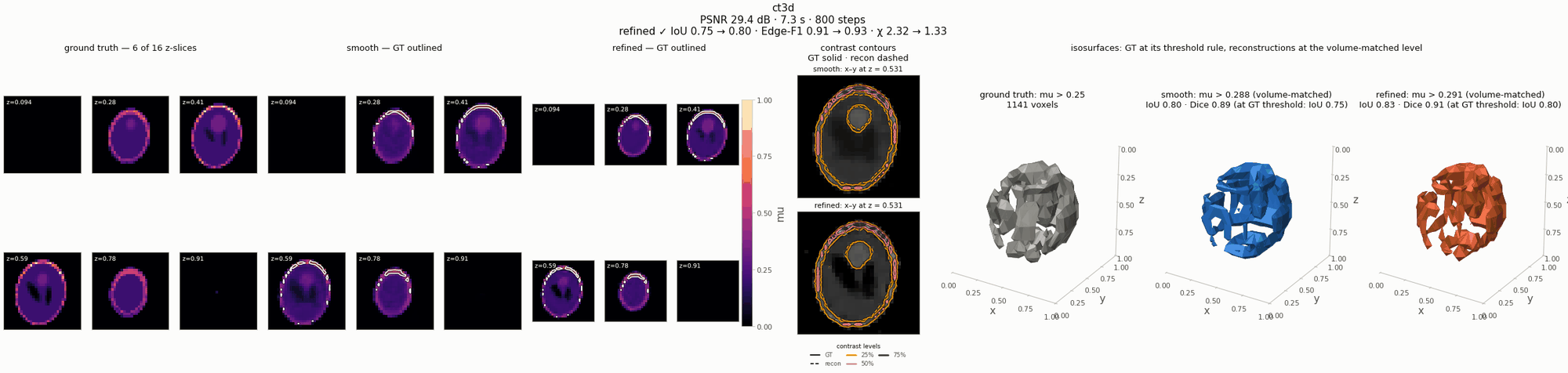
A 3-D Shepp–Logan-like head from 12 parallel-beam projections of every slice. The refinement keeps a crisp air/object boundary around a free multi-tissue interior (instance page).
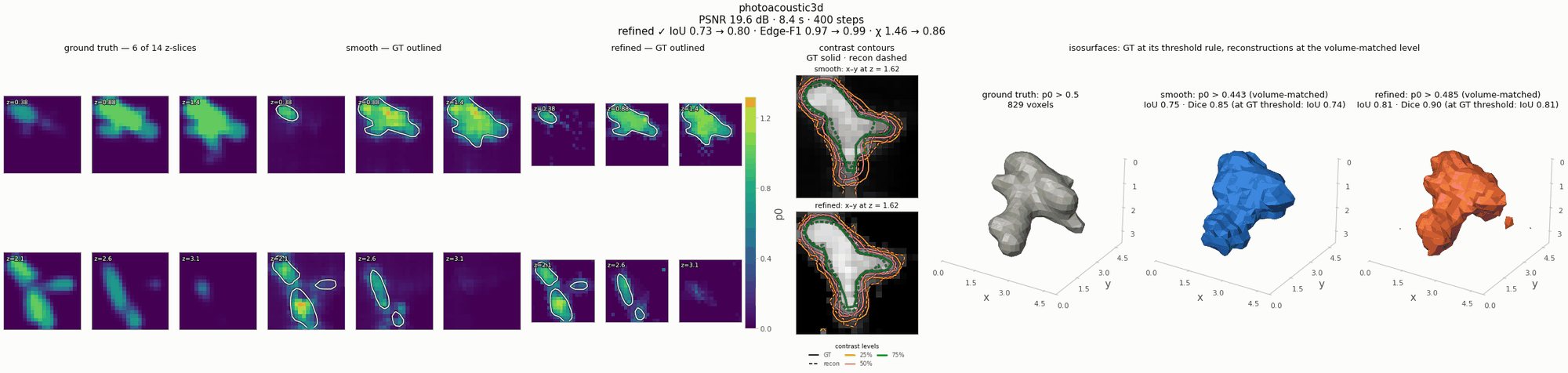
A vessel network seen from one side by a planar sensor array (limited view), through a 3-D wave solver (instance page).
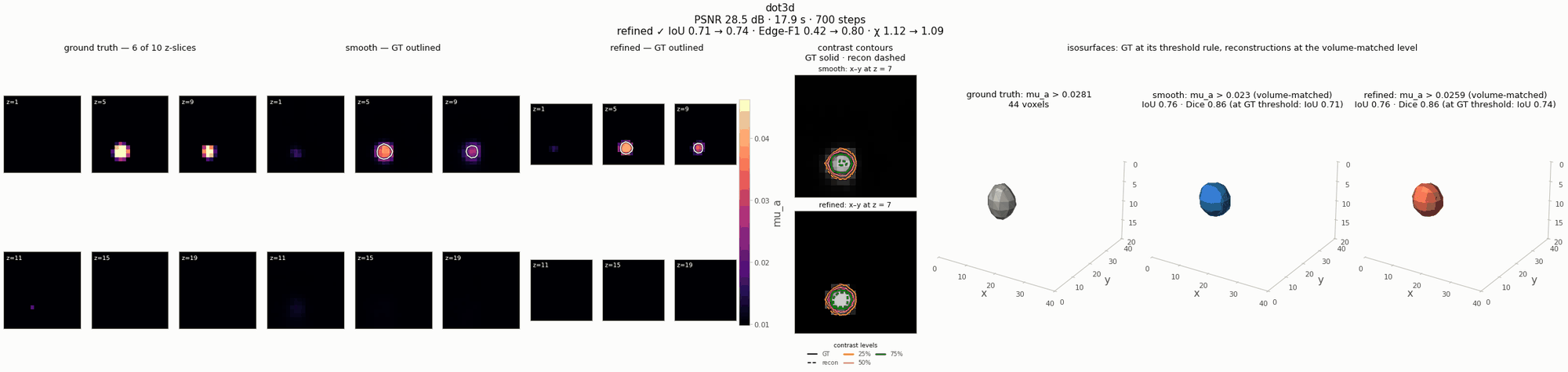
An absorbing inclusion in a scattering slab, recovered from surface reflectance through an elliptic diffusion solver with an implicit-function adjoint (instance page).
How to read a viewer¶
- Panels. Ground truth (grey), the smooth reconstruction (blue) and the edge-refined one (orange), always on the ground truth's grid.
- Levels. The ground truth is thresholded with the instance's own IoU rule (the same rule as the benchmark metric). Each reconstruction is drawn at the volume-matched level by default — the level whose isosurface encloses as many voxels as the ground truth's — so shapes are compared independently of contrast calibration. The recon level menu switches to the ground truth's threshold, Otsu or a manual level; IoU and Dice update in the browser.
- Views. Isosurface, thresholded voxels, a movable slice, or isosurface + slice; GT overlay draws the ground-truth surface over each reconstruction; display applies a smoothing or sharpening transform to the reconstructions only, and says so.
- Numbers. At the ground truth's threshold the in-browser IoU equals the instance's IoU metric: the quantized volumes are nudged so that the rule selects exactly the voxels it selects in full precision (these grids are small enough to need no downsampling).
Isosurfaces of all five systems¶
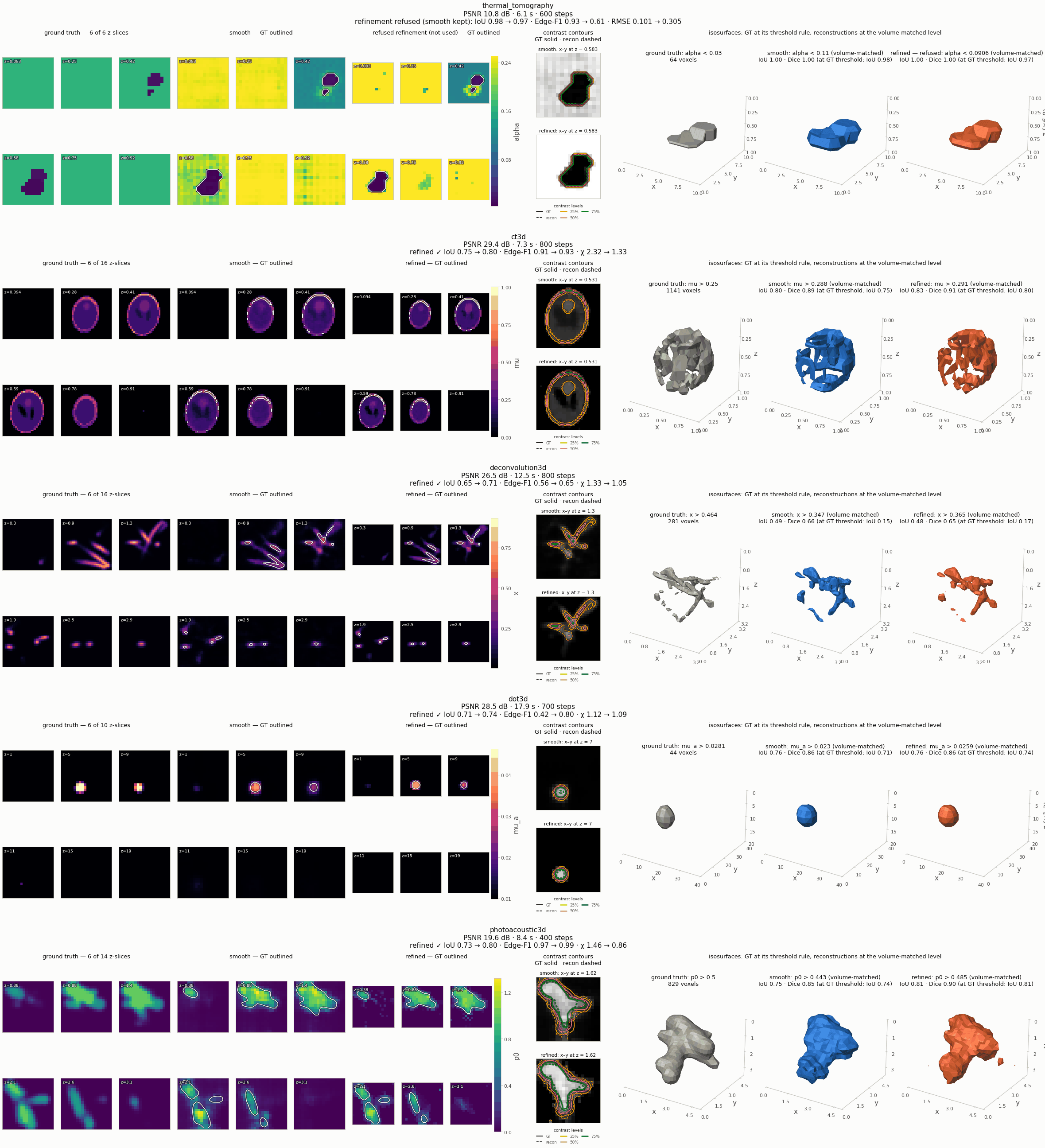
| system | refinement | IoU (smooth → refined) | Edge-F1 | data fit χ |
|---|---|---|---|---|
thermal_tomography |
refused (smooth kept) | 0.98 → 0.97 | 0.93 → 0.61 | RMSE 0.101 → 0.305 |
ct3d |
accepted | 0.75 → 0.80 | 0.91 → 0.93 | 2.32 → 1.33 |
deconvolution3d |
accepted | 0.65 → 0.71 | 0.56 → 0.65 | 1.33 → 1.05 |
dot3d |
accepted | 0.71 → 0.74 | 0.42 → 0.80 | 1.12 → 1.09 |
photoacoustic3d |
accepted | 0.73 → 0.80 | 0.97 → 0.99 | 1.46 → 0.86 |
A refinement is accepted only when the refined field explains the data within tolerance and its interfaces stay inside the smooth solution's transition band; the thermal case shows the refusal at work. See Edge refinement for the controls and the full benchmark.
One system at a time¶
Make your own viewer¶
from nefi import viz

viz.save_volume_viewer(
    "runs/my_run/viewer.html",
    {"ground truth": gt, "reconstruction": rec},     # tensors or arrays, first = reference
    extent=inst.domain(),                            # physical axes and aspect ratio
    threshold=viz.voxel_rule(inst, gt),              # the instance's IoU rule
    mode="iso",                                      # "iso" | "voxels" | "slice" | "iso+slice"
)
Volumes are area-averaged to at most 64 voxels per axis and quantized (16-bit up to 48³
voxels); the viewers on this page weigh 108 kB (dot3d), 184 kB (photoacoustic3d) and
448 kB (ct3d). examples/gallery.py --html embeds one viewer per volumetric system in its
report. Details: Visualization § 2.3.