Baselines¶
A baseline in nefi changes only the parameterization or the optimizer: the domain, the
forward operator, the losses, the measurement and the post-processing stay identical, so a
comparison isolates the prior. Every instance can run every baseline through
nefi.baselines.baseline_problem; see Baselines for what each one means and
when a comparison is fair.
Same data, six methods¶
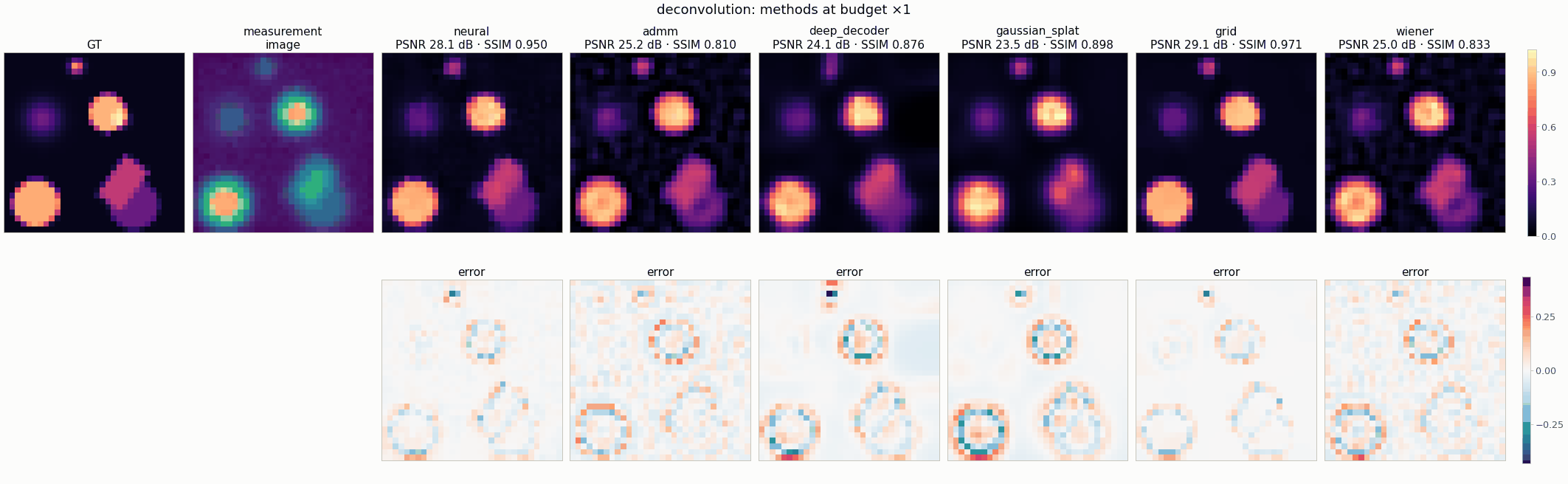
deconvolution, phantom scene, 32², Gaussian PSF, 1 % noise, the same
objective and budget for every iterative method (gallery run, CPU). The TV-regularized
grid — the MAP estimate of this objective — is the strongest method on this well-conditioned
linear problem; the neural field is close behind and well ahead of Wiener, the Deep Decoder, the
Gaussian splats and ADMM.| method | PSNR [dB] | SSIM | parameterization |
|---|---|---|---|
| neural field | 28.1 | 0.950 | coordinate MLP + annealed Fourier features |
| grid + TV | 29.1 | 0.971 | free pixels (NeTMY "Tikhonov", NeFTY "Grid Opt.") |
| ADMM (ℓ1 + box) | 25.2 | 0.810 | splitting solver on pixels |
| Deep Decoder | 24.1 | 0.876 | untrained convolutional decoder |
| Gaussian splats | 23.5 | 0.898 | adaptive Gaussian primitives |
| Wiener | 25.0 | 0.833 | closed form |
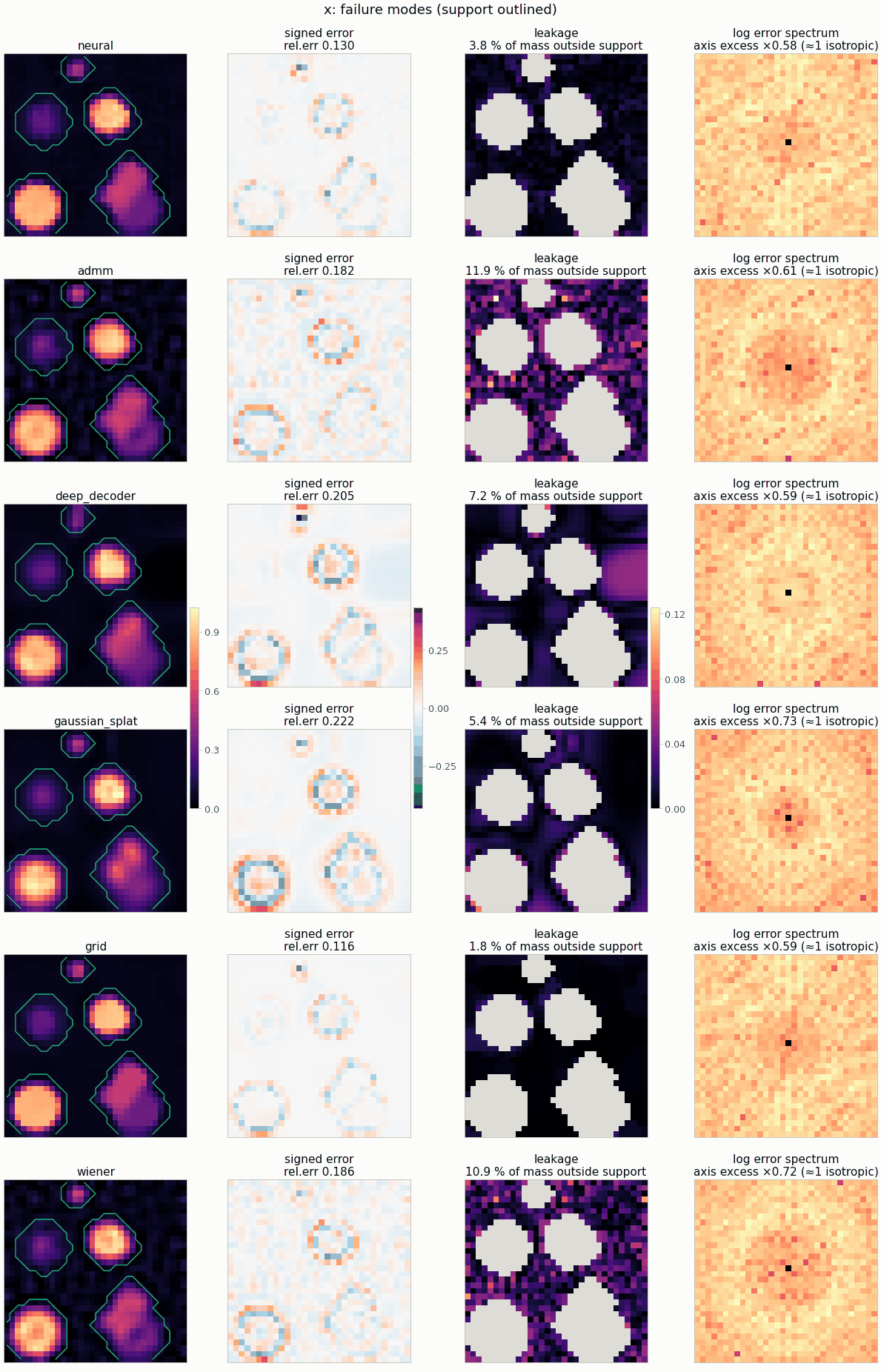
How each method fails¶
When does the representation matter?¶
The ranking depends on the regime, and the documentation reports it either way:
- Well-conditioned linear problems with an explicit prior (deconvolution, sparse-view CT with enough views, Poisson source): the TV grid is the MAP estimate of the objective and a very strong baseline; the neural field is competitive (deconvolution, sparse-view CT).
- No explicit prior: the parameterization becomes the only regularizer. On deconvolution with 3 % noise and no TV, the neural field reaches 29.4 dB where the free grid fits the noise (23.0 dB) (Baselines § 4).
- Missing data: in limited-angle 3-D CT the neural field wins on PSNR and structure (90° wedge: 24.9 dB / SSIM 0.78 against 23.7 dB / 0.62 for the grid) (ct3d).
- Biased raw gradients: under NeTMY's tensor operator a free density collapses toward the center; the filtering kernel of the neural field is decisive (The representation is the prior).
- Surface-only heat data: the voxel grid finds no defect (IoU 0) where NeFTY's neural field reaches IoU 0.97 on the same measurement (thermal tomography).