The representation is the prior¶
Choosing how the unknown is parameterized decides which image-space updates gradient descent can make, how fast each spatial frequency converges, and what the reconstruction can and cannot contain. Each physical system therefore calls for a representation whose geometry matches the unknown and whose spectral filter matches the operator's decay — and when we do not know which, the measurement itself can tell us.
This is the thesis nefi distills from NeTMY and NeFTY, and the reason the library treats the representation as a first-class design axis rather than an implementation detail.
The filtering view¶
NeTMY, Lemma 2. A first-order step on the parameters, \(\theta \leftarrow \theta - \eta\,\nabla_\theta L(f_\theta)\), realizes to leading order the image-space update
\(G_\theta\) is positive semidefinite: every update is the raw data gradient filtered by the representation. What that filter looks like depends entirely on the parameterization:
| representation | \(G_\theta\) | consequence |
|---|---|---|
free grid (GridField) |
\(I\) | executes the raw gradient verbatim — center bias, noise at all frequencies |
| MLP + annealed Fourier features | smooth kernel whose band opens with annealing | low-pass early, detail later |
| Fourier basis | an ideal projector | a hard bandwidth, nothing above the cutoff |
| Gaussian splats | low rank, localized | moves primitives, cannot fill dense regions |
| shapes, layers, level sets | columns concentrated on interfaces | moves boundaries, not pixels |
| coordinate warp | the inner filter at warped coordinates | local bandwidth: detail where the warp stretches |
What it predicts¶
Center collapse (NeTMY). Under the tensor dipolar operator, the data gradient of a uniform
density is strongly peaked at the center of the field of view: nefi's iter0_gradient
diagnostic measures a center / outer-ring ratio of 112× at 32² (the paper reports 18.29× on its
own geometry), against 0.33× — no center bias — under the scalar F1 operator. A free grid
(\(G_\theta = I\)) follows that gradient into a collapsed solution; the neural field's kernel
spreads the update and escapes it. Diagnostics reproduces the
analysis for any problem.
Interior blindness of soft constraints (NeFTY). The heat equation's singular values decay algebraically (Prop. 2), so the surface data constrain the interior only through a hard, exactly solved PDE. With the physics as a soft residual, a network can fit the surface while leaving the interior untouched; with the physics as a hard constraint the only freedom left is the representation — a bounded field with TV, whose filter favours compact, piecewise-constant defects.
Per-frequency convergence. Linearizing around the solution of a translation-invariant problem with operator sensitivity \(\sigma_F(\nu)\) and representation transfer \(g(\nu)\), the error at frequency \(\nu\) evolves as
A representation is matched when its pass band coincides with the band the data resolve above the noise, over-bandlimited when it cannot express what the data resolve, and under-bandlimited when it moves frequencies the data do not constrain (and fits noise unless annealing, TV or early stopping stops it).
Measuring it¶
nefi.fields.adaptive.match_report(field, problem) measures both sides — \(g\) from rows
\(G_\theta e_i\), \(\sigma_F\) from rows \(J^\top J e_i\) — and states the verdict in words.
select_representation lets held-out entries of the measurement choose among candidates.
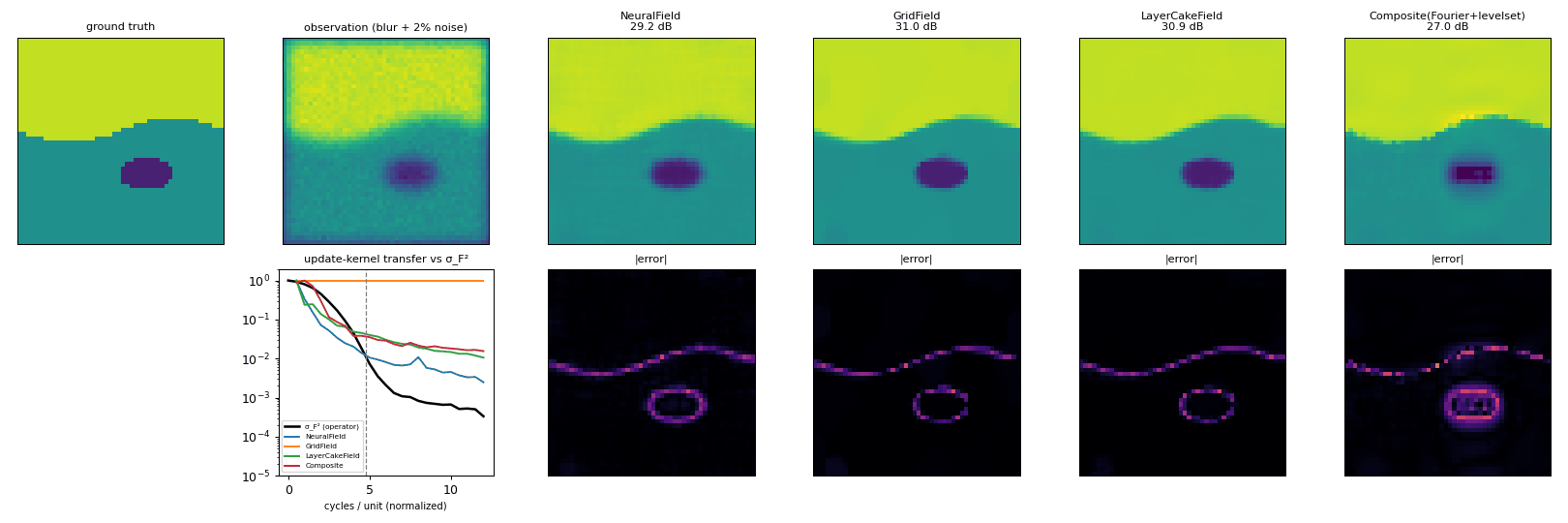
examples/geometric_representations.py). Bottom left: the update-kernel transfer
of each representation against the operator's sensitivity σF²; the dashed line is
the band the data resolve.| representation | parameters | PSNR [dB] | defect IoU | match verdict | held-out val/σ² |
|---|---|---|---|---|---|
NeuralField (6 octaves) |
11 777 | 29.2 | 0.93 | over-bandlimited | 2.37 |
GridField + TV |
2 304 | 31.0 | 0.97 | under-bandlimited | 1.15 |
LayerCakeField (layers ⊕ gated anomaly) |
2 926 | 30.9 | 0.96 | matched | 1.01 |
CompositeField (Fourier background ⊕ level set) |
2 946 | 27.0 | 0.72 | over-bandlimited | 1.88 |
The layered representation is the only one whose pass band matches what the data resolve; it recovers the physical parameters (layer values 1.04 / 0.552 against 1.0 / 0.55) with 2 926 parameters, and held-out cross-validation picks it — it predicts unseen measurement entries at the noise floor. The TV grid is a strong baseline for piecewise-constant images under mild blur, and the report says why: it is under-bandlimited, and TV is what keeps it in check.
In practice¶
- A decision guide from the geometry of the unknown to a representation, an annealing schedule and regularizers: Geometric representations § 3.
- Adaptive tools — residual- and operator-aware annealing, capacity growth, held-out selection and ensembles: § 4.
- After the fact — a smooth result can be re-represented as a multi-phase level set under the same physics and data: Edge refinement.
- When the representation does not matter much — linear problems with a well-tuned explicit prior: Limitations and caveats.